

A parent’s words can stay with you, especially when criticism, guilt or comparisons happen repeatedly. You may love your parent and still feel hurt by the way they speak. You do not have to settle on a label for the whole person before taking your own experience seriously.
This guide is mainly for adults navigating a relationship with a parent. If you are a child or teenager being frightened, threatened or repeatedly humiliated at home, seek help from a trusted teacher, school counselor, healthcare professional or another safe adult. You are not responsible for teaching an adult to treat you well.
On this page

Look at the pattern and the response to repair
An impatient remark followed by a sincere apology differs from a repeated pattern of humiliation or threats. Consider what was said, how often it happens and whether your parent acknowledges the effect when you raise it.
Useful repair includes naming the behavior, listening without demanding reassurance and changing what happens next. “I am sorry you are sensitive” does not address an insult. At the same time, you cannot know someone’s entire motive or childhood from a phrase alone.
The American Academy of Pediatrics’ discipline guidance advises against shaming and harsh verbal punishment and encourages calm limits and adults repairing their mistakes. Parents can guide behavior without attacking a child’s worth.
When sacrifice is used to create a debt
“After everything I have done for you” may appear in a conversation about money, visits or a life decision. A parent can describe genuine strain and ask for help. The concern is using past care to insist that you surrender choices or accept mistreatment.
You might say, if safe: “I appreciate what you have done. I can help with this appointment, but I cannot agree to every request.” Gratitude and limits can exist together. You do not need to compare every expense or prove that your parent never struggled.
If there is a current financial agreement, discuss its actual terms separately. Shared housing, caregiving or debt may create practical obligations; they do not make humiliation acceptable. Seek independent advice when an agreement is unclear rather than making promises under pressure.
When criticism becomes a judgment of who you are
“What is wrong with you?” or “You are just like your father” shifts attention from a specific disagreement to your character or another family relationship. A comparison does not explain what needs to change.
A possible reply is: “We can discuss what happened. I will not continue while I am being insulted.” You can also pause without explaining further, particularly if answering tends to make the situation worse.
When one parent criticizes the other through you, you do not have to defend either adult or act as a messenger. “Please speak to them directly about that” may be enough when it is safe to say.
Being reminded of a painful relationship may explain a parent’s feeling, but it does not excuse directing contempt at you. Avoid trying to solve the argument by proving that you are nothing like a sibling or another parent.
When a limit is called selfish or disobedient
Someone may dislike a limit and still respect it. Notice whether “selfish” is being used to prevent any discussion of your time, health, privacy or responsibilities.
Make the limit specific: “I can visit on Sunday for an hour,” or “I am not discussing my dating life today.” You can care about a parent’s disappointment without treating it as an instruction to change your answer.
For adults, “You must do whatever I say” deserves a different response from a reasonable shared-household rule. Clarify the actual issue: cleaning a shared kitchen is different from controlling who you may befriend.
If you depend on your parent for housing, disability support or money, a direct confrontation may have consequences. Quiet planning, outside support and a smaller boundary may be more workable. Having limited options is not a failure of courage.
Choose support and contact that fit your circumstances
Options include changing a topic, shortening calls, meeting in a neutral place, taking a pause or reconsidering contact. You are not required to maintain closeness at any cost, and no single contact rule suits every family.
If you fear violence, retaliation or being made homeless, seek individual help from an appropriate local support service before announcing a major change. Use a safer device if monitoring is a concern. Contact local emergency services if there is immediate danger and you can safely do so.
If you are a parent recognizing your own words here, start with a clear apology and a practical change. These ideas for positive parenting and working through parental guilt can support that work. Your child should not have to comfort you before their hurt is heard.
When a parent calls a child lazy during an argument
A parent might say: “I called you lazy. That was hurtful and I’m sorry. Next time I’ll ask what made the task hard.” Give the child time to respond and use the new approach later.
Repeated insults or threats require more attention than a single apology. A trusted support person can help children or adults consider safer options.
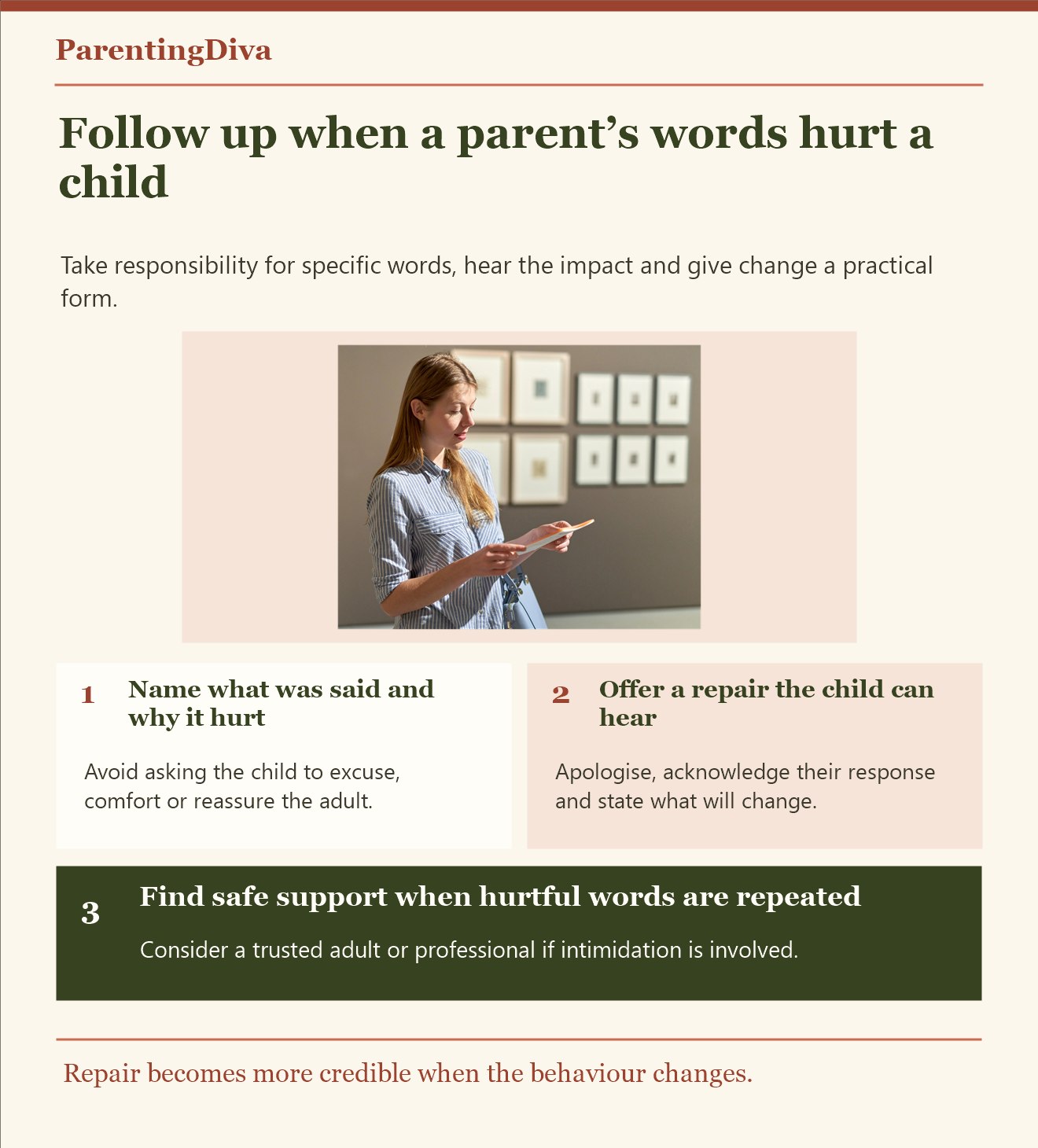
Read the infographic in text
Follow up when a parent’s words hurt a child
Take responsibility for specific words, hear the impact and give change a practical form.
- Name what was said and why it hurt Avoid asking the child to excuse, comfort or reassure the adult.
- Offer a repair the child can hear Apologise, acknowledge their response and state what will change.
- Find safe support when hurtful words are repeated Consider a trusted adult or professional if intimidation is involved.
Repair becomes more credible when the behaviour changes.