

Being a queer parent can involve ordinary family logistics alongside choices about privacy, identity and community. You might be parenting alone, with a partner, with a co-parent or within a wider network of care. There is no single family arrangement or coming-out story that you need to fit.
If people make assumptions about your family, you can decide what to correct, what to share and what to keep private. Your capacity to care for your child is not something you need to prove through a personal explanation. Start with the support and everyday arrangements that matter to your household.
In this article

Choose what you want to share
A conversation at a school gate or birthday party does not require your full family history. You can give a short answer, redirect the conversation or say that a question is personal. “That arrangement works for our family” may be enough. You do not need to make every curious person understand everything about you.
If someone offers to arrange a date, you can accept, decline or clarify what you want. “Thanks, but I’m not looking to date” does not require any further disclosure. If you do want an introduction, tell them only the information you are comfortable having passed on, and ask them to check with you first.
You may be open in one setting and private in another. Consider your safety, comfort and the people affected before sharing. Avoid treating disclosure as a test of confidence or assuming that a partner’s presence makes someone’s identity obvious.
Give your child words and room to ask
Use the family names and descriptions that fit your household. A simple explanation might be: “Families can have different people caring for them. These are the people in ours.” Let your child’s questions guide how much more you explain, using language they can understand.
Talk about privacy without making your child responsible for managing adults’ reactions. They should not have to deliver your coming-out conversation, defend your identity or keep track of every person who knows what. Make a plan you can handle as the adult, and allow them to ask for help when a question feels uncomfortable.
As children grow, include them in decisions about sharing their own stories, photos and experiences. Your identity belongs to you; details about their friendships, feelings or family experiences also deserve consideration. Check before posting a personal story that identifies them.
Make everyday settings easier to navigate
For a school, club or childcare setting, identify the practical information staff need: who cares for your child, preferred names, contact arrangements and who handles a particular question. You can ask who will see that information and how updates are managed before sharing more personal details.
If a form assumes a family structure that does not fit, ask how to record your household accurately. A short email can be easier than repeatedly explaining the same thing in person. Keep a copy of any agreed correction so you do not have to start from the beginning next time.
If your child reports a hurtful comment, listen to what happened and what support they want. Contact the appropriate staff member when needed and agree how you will follow up. Your child does not need to settle the situation alone. For serious concerns, seek suitable local support rather than relying on a general conversation about inclusion.
Build a community that fits your family
You may want other queer parents to talk with, people who share a particular family arrangement or simply friends who are reliable and welcoming. Those needs can overlap. An affirming straight friend and a queer-parent group can offer different kinds of connection without either having to meet every need.
Family Equality’s peer-support listings for LGBTQ+ families are one starting point to explore. Check current eligibility, location, times and privacy arrangements directly with the organiser. A group’s title alone cannot tell you whether its format will suit you.
Before joining an online space, consider whether names, photos or discussions are visible outside the group. You can begin by listening and sharing only what feels comfortable. If a space leaves you feeling judged or pressured, you can look elsewhere without explaining your whole decision.
Ask for practical help and protect your own time
Name a specific need: help with a school run, company at an event or a reliable person to call when plans change. Check what another person can actually offer and what arrangements are needed. Support can include chosen family and friends as well as relatives, partners or co-parents.
If you are parenting alone, consider which responsibilities could be shared or simplified. Do not assume that every single parent has the same income, contact with a co-parent or support network. Your plan should reflect the resources available to your own household.
You can enjoy parenting and still need adult company, rest or time that is yours. Choose one manageable next step, such as contacting a group or clarifying a school record. You do not have to solve every assumption other people make before building the family life you want.
When a school introduces families using unnecessary assumptions
Ask which details it needs to know about guardians or emergency contacts. You can give that information and suggest wording that includes different family arrangements. Talk with your child about how they want to handle ordinary questions.
If a setting feels hostile or unsafe, consider trusted community support and the site’s formal options rather than feeling you need to give more personal details.
Read the infographic in text
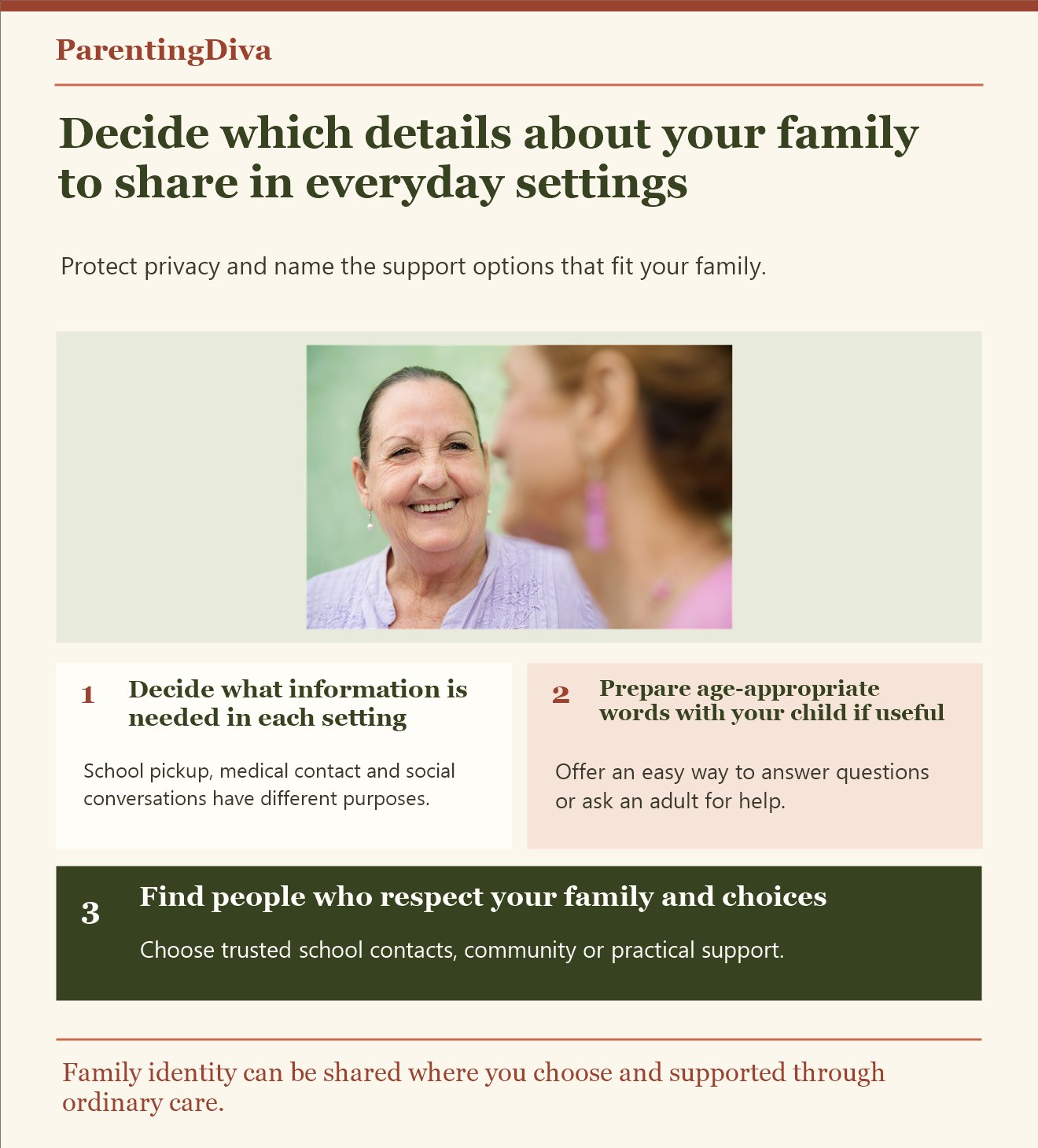
Decide which details about your family to share in everyday settings
Protect privacy and name the support options that fit your family.
- Decide what information is needed in each setting School pickup, medical contact and social conversations have different purposes.
- Prepare age-appropriate words with your child if useful Offer an easy way to answer questions or ask an adult for help.
- Find people who respect your family and choices Choose trusted school contacts, community or practical support.
Family identity can be shared where you choose and supported through ordinary care.