

After you yell, the next useful step is taking responsibility for your response. You can apologize without pretending the child’s unsafe behavior was acceptable or dropping a reasonable limit. The apology concerns how you acted; the limit concerns what needs to happen next.
Pause before the repair conversation
First make sure everyone is safe. If you are still close to losing control, reduce immediate demands and ask a suitable adult for help where available. Do not leave a young child without appropriate supervision to take a break.
Wait until you can speak without restarting the argument. Repair does not require a polished speech or an instant response from your child. It needs clear words and a change in how you handle the next moment.
Name what you did without blaming your child
Use specific language: “I yelled. That was not okay, and I’m sorry.” Avoid “You made me yell” or an apology that turns into a list of the child’s mistakes.
The American Academy of Pediatrics’ guidance on discipline emphasizes teaching and describes the problems with harsh verbal discipline. Taking responsibility is part of showing the behavior you want your child to learn.
Keep the apology separate from the boundary: “I’m sorry I yelled. The tablet still needs to be put away before bed.” You can then offer appropriate help with the task.
Give your child room to react
Your child may be upset, quiet, angry or ready to return to play. Do not require forgiveness, reassurance or a hug to make you feel better. You can offer closeness without making it compulsory.
Try: “You’re allowed to be upset. I’m here when you want to talk.” With a younger child, fewer words may work better. With an older child, listen to their account without correcting every detail before acknowledging the effect of your response.
You remain the adult responsible for your behavior. Your child does not need to comfort you or promise to behave perfectly so that you can stay calm.
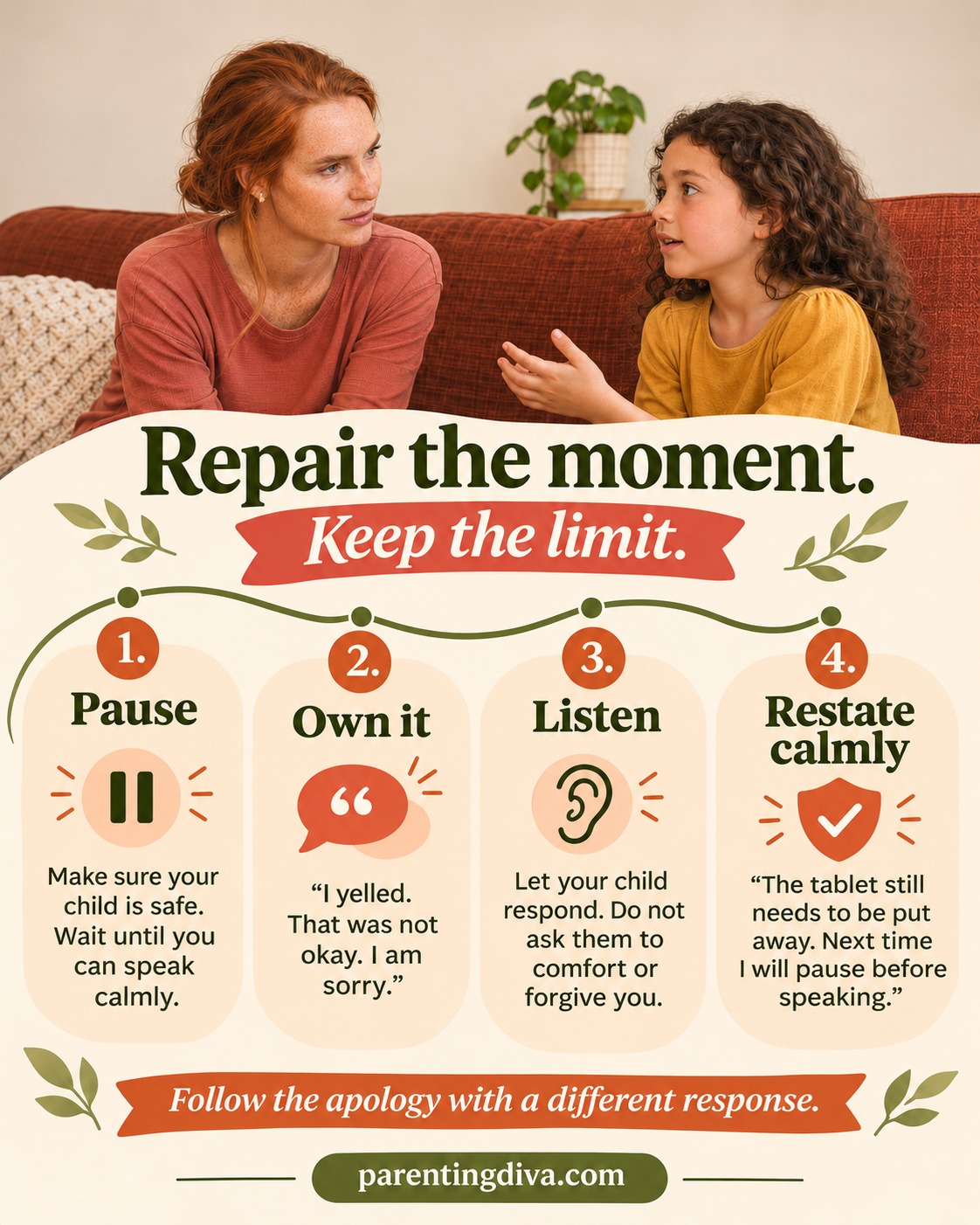
Read the visual guide as text
- Pause. Make sure the child is safe. Give yourself time to speak without another outburst.
- Own it. I yelled. That was not okay. I am sorry. Do not make the child responsible.
- Listen. Give the child space to respond without asking them to comfort or forgive you.
- Restate calmly. The tablet still needs to be put away. Next time I will pause before speaking.
An apology matters most when it is followed by a different response.
Keep necessary limits and reconsider unreasonable ones
A repair can include a clear boundary: “I cannot let you throw the toy at someone. Next time I will help you put it down without shouting.”
If the rule itself was unnecessary or unrealistic, say so: “I thought about it, and that expectation was not reasonable for you. We will do it differently.” Consistency does not require defending every decision you made while frustrated.
Make a change plan you can actually use
- Notice the pressure point: repeated instructions, rushing, noise, fatigue or an unrealistic task.
- Choose an earlier response: move closer, use fewer words, give a transition warning or offer help.
- Arrange support: agree on a caregiver handover or ask for practical help with a difficult part of the day.
- Return to the limit calmly: explain what happens next without demanding a perfect conversation.
For example, if bedtime repeatedly becomes a shouting match, prepare earlier, reduce nonessential steps and choose one short instruction at a time. A plan should reduce pressure, not depend on endless patience in an impossible schedule.
Show repair in ordinary moments
Your next response matters more than repeatedly asking whether the apology was accepted. Listen, follow through on what you promised and acknowledge another mistake if it happens. Repair is not permission for a repeating cycle of frightening behavior.
Coordinate with other caregivers without making the child carry messages or choose sides. Explain the practical plan and what help each adult can provide.
Ask for support before the pattern becomes harder to change
If yelling is frequent, frightening or escalating, seek appropriate parenting or mental health support. If you are afraid you may hurt your child, prioritize immediate safety and urgent help. An apology should not replace protection from ongoing harm.
A simple repair might sound like: “I yelled, and I’m sorry. You can be upset. The rule about throwing is still the same. Next time I will pause and help you put the toy down.” Adapt the words to your child and the actual situation.
You can keep a limit and repair the way you communicate it. Let the apology open the conversation, then make the change visible in daily life.