

Your child wants another cartoon. You turn the television off, and tears follow. You can comfort a disappointed child while keeping a reasonable limit. Support means helping them through the feeling; it does not require making every disappointment disappear.
Start with safety and a short message
Tantrums may happen when a young child is tired, hungry, frustrated, overwhelmed or struggling to communicate. You do not need to settle whether the behavior is deliberate before responding to immediate needs.
Move the child away from a hazard when necessary, protect other people, and reduce competing instructions. If another caregiver is present, one person can stay with the child while the other handles shopping or siblings. Do not use restraint as a punishment.
Keep the limit simple: “I can’t let you hit,” or “The tablet is finished for today.” A long explanation is unlikely to help during intense distress. The CDC’s emotion-coaching guidance combines acknowledging feelings with limits on behavior.
Allow the feeling without allowing harm
Your child may cry, protest or say a rule is unfair. They do not have to agree before the limit can apply, and they do not have to hide their feelings before receiving comfort.
Try: “You wanted more time. It is hard to stop. I’m here.” If they throw a hard toy, add: “I’m putting this away so nobody gets hurt.” You are responding to the feeling and the unsafe action separately.
Offer closeness without making it compulsory: “Would you like a hug, or shall I sit nearby?” Affection should not be a prize for stopping tears. Some children need more space, fewer words or less sensory input.
Meet needs while keeping the boundary
Food, comfort, appropriate clothing and care are not rewards that must be earned. If your child is upset because you will not buy a toy and also needs a snack, you can meet the need without buying the toy: “We’re not buying that today. We can eat our snack outside.”
Leaving an overwhelming event is not automatically giving in. You can decide that a setting is unsuitable while keeping the relevant rule. Consider developmental ability too: a toddler may need help putting a toy away rather than another instruction to do it alone.
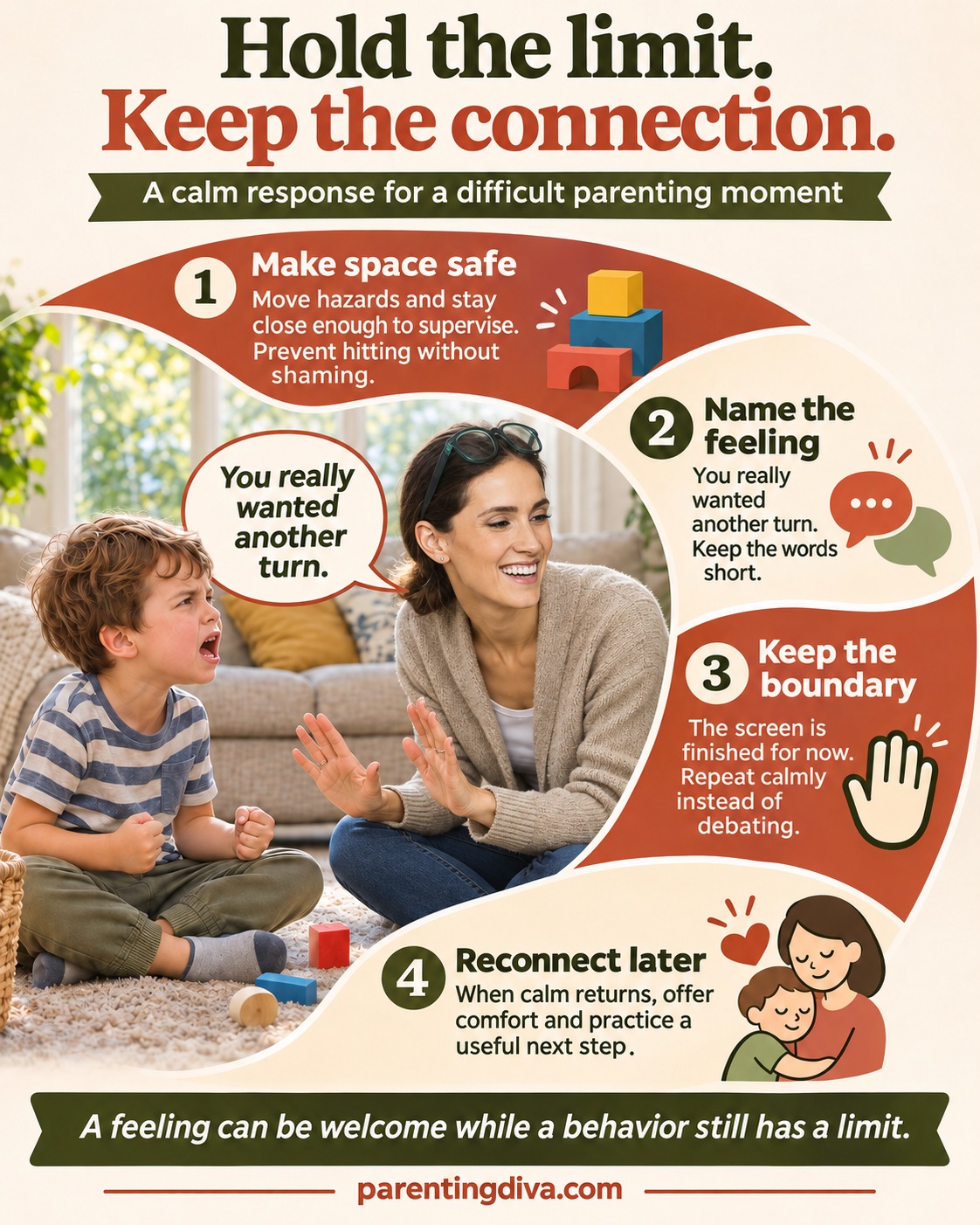
Read the visual guide as text
- Make space safe. Move hazards and stay close enough to supervise. Prevent hitting without shaming.
- Name the feeling. You really wanted another turn. Keep the words short.
- Keep the boundary. The screen is finished for now. Repeat calmly instead of debating.
- Reconnect later. When calm returns, offer comfort and practice a useful next step.
A feeling can be welcome while a behavior still has a limit.
Offer choices you can actually honor
- “It is time to leave. Would you like to carry your backpack, or shall I?”
- “We need to put shoes on. Do you want to sit here or on the step?”
- “I can help you put the blocks away, or you can start with the red ones.”
Both choices should be safe and acceptable. Avoid asking “Do you want to leave?” when staying is not available. If your child cannot choose, calmly provide the help needed instead of repeating the question as a test.
Handle public moments without performing for an audience
Imagine your child asks for candy at the checkout. You say no, and they begin crying. You could say: “You’re disappointed. We are buying our groceries today.” If necessary, ask an employee where you can safely leave the basket while you move to a quieter place.
The outing may need to end early. That does not mean the boundary failed. Later, consider whether a shorter trip, food beforehand or another adult’s help would make a future outing more manageable.
Prepare for transitions and adjust unreasonable rules
Pick one predictable difficulty, such as leaving the playground. Give a concrete warning: “One more slide, then shoes and home.” A familiar routine or extra processing time may help, although preparation cannot guarantee a tear-free transition.
The NHS tantrum guide advises against changing a no merely to stop a tantrum. That is different from responding to new information. If you realize a comfort toy can reasonably come into a waiting room, explain the change rather than defending an unnecessary rule.
Teach after reconnection
Once things are calmer, return to a familiar activity and discuss one skill: asking for help, putting down a toy or taking a break. Avoid turning the conversation into a demand for a perfect apology.
If you yelled, take responsibility for your own response while keeping the needed limit. Seek advice from your child’s clinician when episodes involve repeated injury, significant changes, developmental concerns or disruption you cannot manage with ordinary support. You can also ask for parenting help before reaching a crisis.
A useful plan is small: one clear boundary, one supportive phrase and one practical change to make the next transition easier.